AI in marketing: from content creation to automation and visibility in AI search
AI in marketing – is the use of artificial intelligence to perform marketing tasks, automate processes, and increase business visibility. In practice, AI can help create and customize content, analyze the market and audience, process data, generate ideas, plan marketing actions, and automate repetitive tasks. However, today, AI is important not only as a work tool: ChatGPT, Gemini, Google AI Overviews, and other AI systems are becoming new search and discovery channels where it is also important for businesses to be present.
Therefore, AI in marketing is worth it evaluated in two directions: as a tool, helping you work faster and more efficiently, and as a new organic traffic channel, where potential customers are looking for information, solutions and recommendations.
AI as a tool in marketing
AI in marketing is usually associated with content creation first. This is natural – ChatGPT, Gemini or Claude can help prepare text, suggest headlines, create variations of social media posts, summarize information or help with video content ideas.
But the biggest mistake would be to stop there.
In marketing, AI can and should be used even before content is created. For example, to analyze what questions the audience is asking, what topics dominate competitors' communications, what arguments are missing in the market, or what problems are recurring in customer reviews.
In this case, AI becomes not just a writing tool, but research and analysis tool.
Businesses can also use AI to structure marketing plans, test ideas, shape campaign direction, or interpret existing data. This is especially important for small businesses, as many marketing tasks are performed without a dedicated analytics, content, or strategy team.
From individual tasks to a system
Greater value arises when AI becomes part of a consistent marketing process. For example, blog content should be created not as individual articles, but according to a pre-planned architecture of topics and pages, based on SEO and GEO principles. The same applies to advertising: a greater result is not achieved by individual posts or videos, but by a clear communication strategy, consistent positioning and a main message, according to which all content is created.
AI also helps save time by repurposing content that has already been created. A single blog post can be adapted to multiple channels – from a LinkedIn post, Facebook copy, Pinterest descriptions, a newsletter summary, or a short video script. This way, one high-quality piece of content becomes the basis for broader and more consistent communication.
AI marketing process automation
An even less exploited direction of AI is – marketing process automation.
Here, AI can be combined with other tools so that some of the work can be done without constant human intervention.
For example, when a new article is published on a website, the system can automatically take it, prepare multiple versions of social media posts, adapt them for different channels, and schedule publication.
Another scenario is news monitoring. The system can regularly collect information from selected RSS sources or websites, select the most relevant topics, summarize them, and prepare content for a selected audience.
Such processes are especially useful where there is a lot of repetitive work.
It’s not just publishing that can be automated. AI can help classify queries, summarize customer feedback, analyze recurring questions, generate initial insights for reports, or regularly check selected data sources.
The only important thing is that automation should not mean an uncontrolled flow of content. The more the process is outsourced to the system, the more important it becomes to have clear logic, reliable sources, and human-defined quality criteria.
AI is also changing where people look for information
The impact of AI on marketing doesn't end with internal work processes. Search itself is changing.
People are increasingly asking questions directly to generative AI systems and expecting not a list of links, but a pre-formed answer, comparison, or recommendation.
Google This change is also clearly stated in its official documentation. The company published separate recommendations in 2026 on how to optimize websites for generative search features such as AI Overviews and AI Mode, and highlighted that users are increasingly choosing generative search experiences.
This means that a new question arises for businesses: Do AI systems scan our website, understand what we offer to users, and can use our content to answer a user's question?
AI becomes both a tool and a channel
This is where the two most important directions of AI marketing come together.
The first one is AI as a work tool.
It helps you analyze information faster, create content, generate ideas, structure plans, and automate repetitive tasks.
The second one is AI as a search channel.
ChatGPT, Gemini, Google AI Overviews, AI Mode, and other systems are becoming places where users look for answers and make decisions.
These are two different tasks, but they are directly related.
The better a business structures its information, creates useful content, and clearly communicates its expertise, the more value it gains not only in traditional search, but also in new AI search environments.
Where to start a small business?
You don't need to start with a complicated automation system.
First, it's worth looking at your current marketing process and finding areas where the same work is constantly being repeated.
Maybe social media posts are created from scratch every week.
Maybe the content is published on the website, but it is almost not adapted to other channels.
Data may be collected, but it is rarely analyzed.
Maybe a lot of investment is made in SEO, but no one checks whether the brand is visible at all in ChatGPT, Gemini or Google AI responses. If you want to independently understand whether AI sees and can use your website content in its responses, we suggest using practical AIhelp.lt guides that will help you independently conduct an AI visibility audit, prepare content suitable for AI search, correct weaknesses and consistently improve your website's visibility in AI responses:
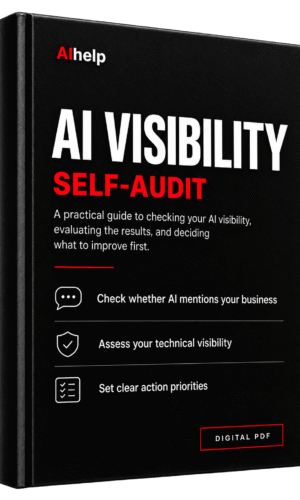
Self-Guided AI Visibility Audit
Step by step, you will check whether ChatGPT, Gemini, Perplexity, Google AI Overviews and other AI systems know, understand, recommend and cite your business. You will identify the main AI visibility problem and priority area for improvement.
→ Conduct an AI visibility audit yourself
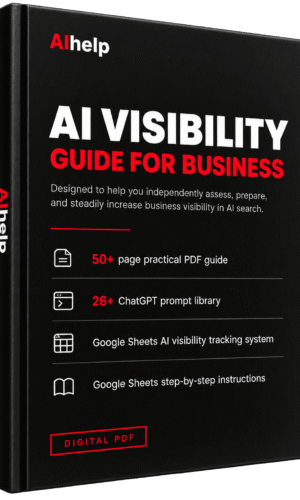
A guide to increasing AI visibility for business
A more comprehensive toolkit for those who want to not only assess the current situation, but also prepare their website for AI search, optimize content, and consistently track visibility changes. The toolkit includes a PDF guide, practical ChatGPT queries, a Google Sheets/Excel tracking template, and a 30-day action plan.
→ Create an AI visibility improvement system
Less manual work. More visibility.
AI in marketing is most valuable when it doesn't create even more content or buzz on social media.
The real value comes when AI helps you spend less time on repetitive work, rely more on data, and be where the potential customer is looking for information.
Therefore, it is worth looking more broadly at AI marketing today.
AI is both the tool we work with and the channel we want to be found in.
Less manual work. More visibility. More organic opportunities to reach customers.