AI GEO Audit: What Does It Cover and Why Is It Necessary in 2026?
Online search is changing. People are finding information not only in traditional Google results, but also Google AI Overviews, AI Mode, ChatGPT, Perplexity, Gemini and other generative systems. That's why it's important for businesses to know not only what position their website occupies in Google, but also whether AI systems find, mention, cite and recommend his brand at all.
This is what helps to assess AI GEO audit, also known as AI visibility audit.
In this article you will learn:
- What is AI GEO Audit;
- How is it different from a traditional SEO audit;
- What technical, content and reputation elements are worth checking;
- How visibility is tested in ChatGPT, Google AI and other AI systems;
- What AI visibility indicators can already be monitored;
- How to translate audit results into a concrete action plan.
What is an AI GEO audit?
An AI GEO audit is a systematic assessment of a website's and brand's visibility in generative search and AI systems.
It aims to determine:
- Do AI systems know and correctly understand your business?;
- Is your brand mentioned in the responses;
- Is your website used as a source of information?;
- Is the business recommended for commercially relevant queries?;
- In which topics do competitors appear more often?;
- Can AI and search engines technically access the most relevant content?;
- What pages or information are missing;
- What actions should be taken first?.
What does an AI GEO audit cover?
1. Setting the initial AI visibility
The audit should not start with fixing the website, but with determining the current situation.
First, the most important queries are selected, based on which a potential customer could search for your product, service or solution.
For example, it’s not enough for a beauty salon to test just its brand. It should also test query directions such as:
- The best [service] providers in a specific city;
- Where to perform [service];
- Which [service] to choose for a specific problem;
- [Service A] or [service B];
- Recommend reliable [service] providers.
The results are checked in several AI systems and recorded:
Mention – AI identifies your brand.
Quote/Source – AI presents your website as a source of information.
Recommendation – your business is presented as a possible choice for the user.
These three results are worth considering separately. A business may be known to the AI system, but not be recommended for the most important commercial queries.
2. Query and buyer path analysis
Brand name testing alone does not provide a complete picture of AI visibility.
A good audit covers different stages of the user decision.
Trademark inquiries
Does AI know your company, website, and field of activity?
Category queries
Does your business appear when a user searches for a specific category of services or products?
Problem or need inquiries
Can AI connect your product or service to the problem a customer is trying to solve?
Comparison queries
Does your brand appear among alternatives when a consumer compares multiple solutions?
Referral requests
Does AI add your business to a list of recommended providers or products?
Such analysis is much more valuable than a single question, „Does ChatGPT know my business?“, because it shows, at which point in the buyer's journey is visibility lost.
3. Technical accessibility for Google and AI systems
Before optimizing content, you need to check whether the most important pages of your website are accessible to systems that can use them.
There are no specific additional technical requirements for Google AI Overviews and AI Mode. In order for a page to be listed as a supporting resource, it must be indexed by Google and eligible to appear in search results with an excerpt.
During the audit, it is worth checking:
- Google indexing;
- robots.txt;
noindexand other robot settings;- Canonical tags;
- Site map;
- Internal links;
- Availability of the main content in text format;
- Mobile use;
- Page performance problems;
- Server or CDN blocks.
If ChatGPT visibility is also considered, it is worth checking OAI-SearchBot access. OpenAI states that it is OAI-SearchBot that is used to discover sites in ChatGPT search results. It is separate from GPTBot, which is concerned with crawling content for training models.
This is an important difference: AI search visibility and permission to use content to train models are not the same thing.
4. Analysis of content quality and thematic depth
During an AI GEO audit, content should not be judged based on whether it „uses a keyword often enough.“.
It is more important to assess whether the page:
- Clearly answers the user's main question;
- Provides complete and correct information;
- Have specific examples;
- Provides original insights;
- Does not rewrite general information available on the Internet;
- Has a clear author;
- Cites reliable sources when needed;
- Regularly updated if the topic changes;
- Naturally linked to other pages on the same topic.
Google recommends focusing on unique, reliable, expert-created and useful content for people, rather than a mass rewriting of generic information.
Therefore, the question of a good GEO audit is not:
„"Does the article have enough H2 headings?"“
More important question:
„"Is there information on this page that would make Google or an AI system choose this particular resource over ten other similar pages?"“
5. Verification of the original expert value
In previous descriptions of GEO, the term is sometimes used EEAT + O, where the letter O stands for originality. However, this is not an official Google standard or a separate Google scoring model.
Google officially uses the term EEAT:
- Experience – experience;
- Expertise – competence;
- Authoritativeness – authoritativeness;
- Trustworthiness – reliability.
Google also emphasizes the importance of original information, research, analysis, and added value, but there is no separate official EEAT+O indicator.
Therefore, during the audit, it is worth looking not for the alleged "EEAT score", but for real signals of reliability and competence:
- Author information;
- Professional experience;
- Primary sources;
- Own tests;
- Case studies;
- Original photos or data;
- Practical methodologies;
- Clear company information;
- Exact publication and update dates.
6. Structural data verification
Schema.org structured data remains a useful part of an SEO audit. It helps Google better understand certain page objects and can provide an opportunity to appear in advanced search results.
However, it is important not to overdo it.
Google 2026 clearly states that there is no special Schema tag for generative search, and structured data is not a prerequisite for AI Overviews or AI Mode to appear.
The recommendation to implement FAQ Schema everywhere just for SEO purposes is also outdated. Google will no longer show FAQ rich results as of May 2026, and removed the documentation for this feature in June.
This doesn't mean that FAQ sections are no longer needed. A good FAQ is still useful to the reader and can help cover a topic in more detail. However, it shouldn't be created just to get an advanced result for a non-existent FAQ.
How often should AI GEO be audited?
There is no single universal interval.
If the website is small and its content changes infrequently, a detailed audit can be performed several times a year, and the most important queries can be monitored more often.
For e-stores, service businesses, or competitive markets that actively publish content, it is more practical to:
Constantly monitor the most important queries → assess changes monthly → conduct a broader analysis quarterly.
The most important thing is not the audit date itself, but the ability to compare:
previous situation → changes made → new result.
Read more about how Google AI Overviews and AI Mode are changing SEO strategy in the AIhelp.lt article. How are Google AI responses changing SEO strategies in 2026?
FAQ
Summary
The AI GEO audit in 2026 is not a check for "AI SEO tricks", but a broader assessment of website visibility.
It helps to understand:
- Can Google and AI systems access the most important content?;
- Is the brand understood correctly?;
- Is it mentioned, cited and recommended?;
- What actions should be taken first?.
Google AI Overviews and AI Mode didn’t kill SEO – they expanded the environment in which businesses can be discovered. Google itself emphasizes in 2026 that core SEO practices remain the foundation for generative search visibility.
At the same time, ChatGPT and other AI systems create an additional visibility channel that traditional keyword positions do not show.
Therefore, a good AI GEO audit must answer not the question „"is our website optimized for AI?"“, and to a much more practical one:
„"Where does our business stand today in AI search, where are our competitors ahead of us, and what do we need to change first?"“
Want to check your website's AI visibility yourself?
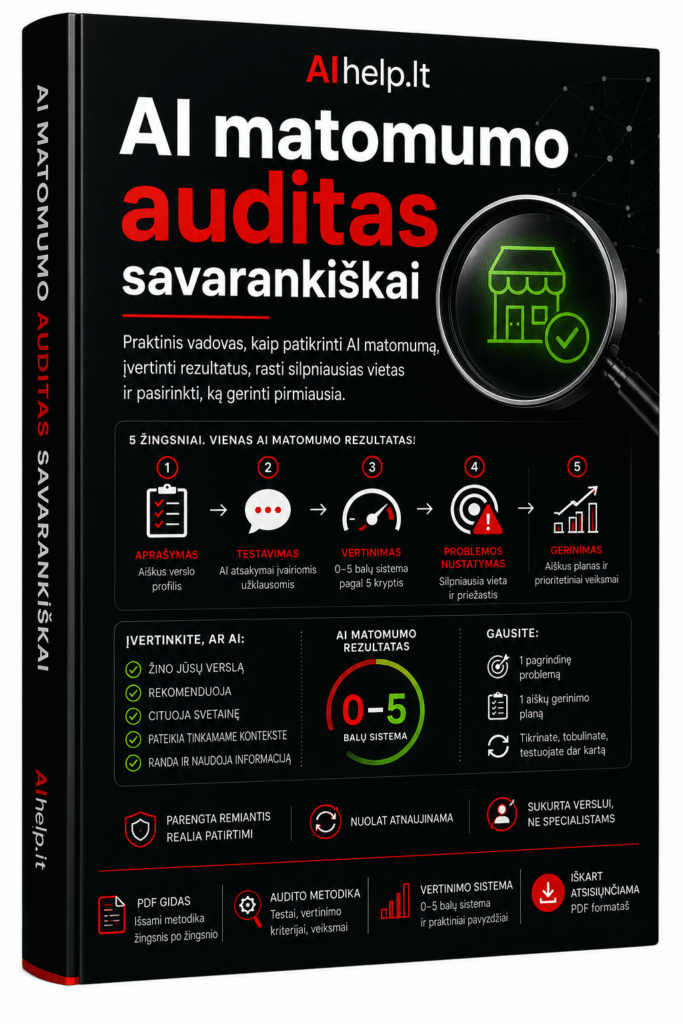
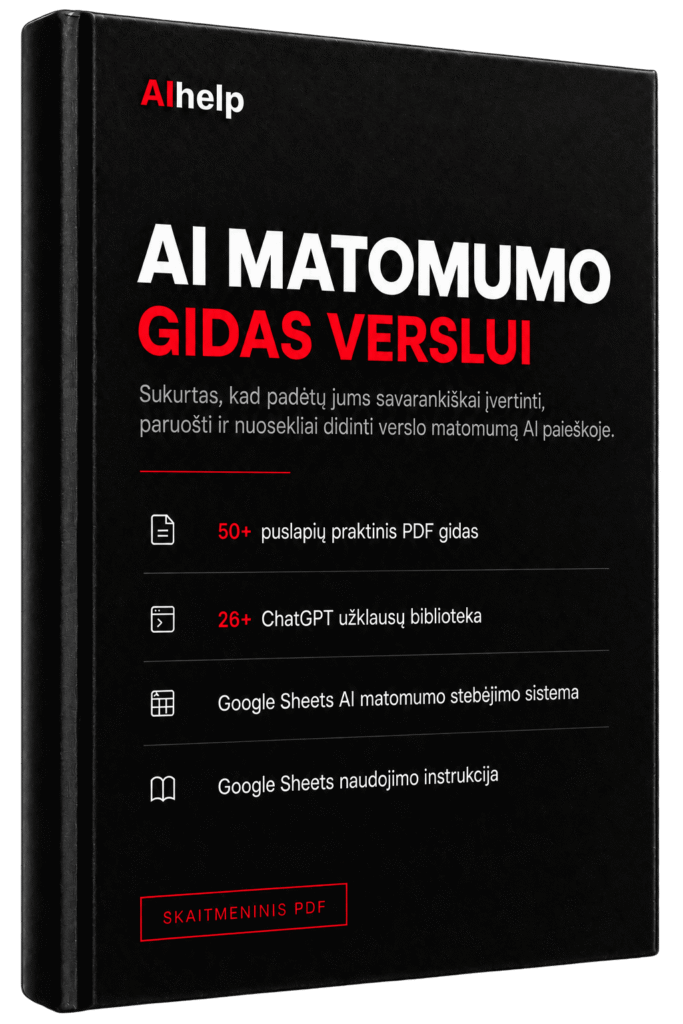
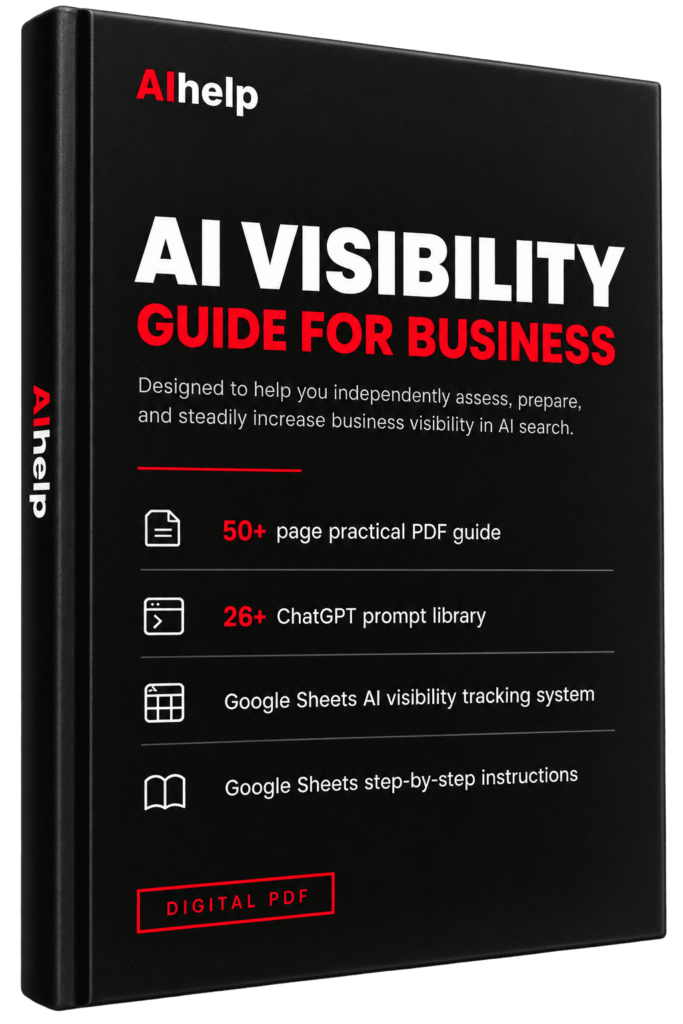
If you want to conduct the audit yourself, read AI visibility audit self-guided provides a structured methodology for testing, evaluating results, and identifying the problem.