
SEO and GEO: how to combine optimization for Google and AI search?
SEO and GEO can and should work together, so businesses don't need to develop two optimization strategies. This may sound like a bold statement, but at least in Google's case, it is based on the official position of the platform itself. Google has its own 2026 Generative Search Optimization Guidelines clearly emphasizes that SEO principles remain at the core of generative Google search: AI Overviews and AI Mode are based on the Google Search index, core ranking and quality systems. In other words, from Google's perspective, generative search optimization is not a separate discipline from SEO - it is an extension of it in the new search environment.
However, GEO includes more than just Google AI search, but also ChatGPT, Claude, Perplexity and other AI systems, which don't work quite the same way as Google. That's why it makes the most sense for businesses today not to choose between SEO and GEO, and to understand, where these two directions overlap, where they differ, and how to combine them in one website strategy.
What are the differences between SEO and GEO?
First of all, the goals of SEO and GEO differ:
- The goal of SEO is to help search engines find, understand, index, and properly present website pages in search results;
- The goal of GEO is to help AI systems understand what your business is, what makes it unique, what questions your content can answer, and when your website can be useful as a resource or recommendation.
So, the goal of GEO EO is broader than the goal of SEO. In the case of SEO, we aim for position in search results and clicks, while in the case of GEO, the goal is to make the business mentioned in the AI response, provided as a source, cited, included in a list of recommendations or comparisons, or shown as a link to additional information.
SEO remains the foundation in Google AI search
In May 2026, Google announced a separate guidelines for optimizing generative search, which state that no need to create a new AI SEO just to get to Google AI Overviews or AI Mode. Google's position has remained moderate - for a page to be used in Google's generative search, it must first be accessible to Google, indexed, and suitable for display in the regular Search system. Technical SEO, site structure, indexing, content quality, and page experience remain equally relevant.
This means that GEO should not start with AI optimization techniques, but rather continue to strengthen SEO, and the main question remains the same: Is our website generally understood and indexed properly by search engines?
If the most important service or product pages are not indexed, content is duplicated, the site structure is chaotic, or search engines cannot access the pages, additional GEO actions will not solve the problem.
AI search is changing the queries themselves
Traditional SEO strategy works with individual keywords, but in generative search, a person can ask a much more complex question, for example:
Which CRM system should I choose for a team of five people if we use Gmail, don't want a programmer, and it's important to automate sales tracking?
As indicated 2026 AI Optimization Guidelines, Google AI Mode can apply the so-called query fan-out – a system that breaks down the initial query into several related searches, collects information from different sources, and then forms a response.
As a result, it is no longer enough for a business to simply have a page optimized for one form of a keyword. More importantly in detail and clearlyanswer real user questions and needs. For example, if you are selling a CRM system, a page about it alone may not be enough. A person may be interested in integrations, prices, company size, ease of use, feature comparison, implementation time, or specific usage scenarios. Therefore, the content of the website must contain this real information necessary for the decision.
Where do SEO and GEO overlap?
First of all, both SEO and GEO strengthen the visibility of AI. Therefore, in both cases it is important technical website structure and content quality.
Google needs to be able to find and index pages, and for ChatGPT search, it is important that the site's content is accessible to the OpenAI search robot. OpenAI officially states, that to help a website be discovered, submitted, and cited in ChatGPT search, it should not be blocked OAI-SearchBot, but this alone will not guarantee a specific position or mention.
The second criterion that evaluates AI is content quality. Google's 2026 roadmap particularly emphasizes the so-called non-commodity content – content that is not just another generic retelling of information already available on the internet. Greater value has original experience, specific examples, expert assessment, own data and a clear approach. So, if you provide an identical answer on your website as on other websites, the chances of being mentioned by the AI system will remain low.
What content is suitable for AI search?
Google clearly states that there is no need to rewrite texts so that they are better understood by AI systems, and there is no need to create a separate page for each possible query formulation. Google systems are able to understand synonyms, context, and semantic relationships even when the page does not contain the exact user question.
In practice, this means something else – content should be created in such a way that a person would quickly find a clear answer and be able to continue making a decision. For example, on a service page, it is not enough to write: we provide professional SEO services for business, a more detailed explanation is needed who the service is for, what problem it solves, what specifically is done, how the process works, what result can be expected, what limitations and how the solution differs from alternatives.
In short, content that is useful to a human, user-friendly, will be acceptable to Google and generative systems.
Is structured data important for GEO?
Yes, structural data is important in GEO, but not as strongly as is sometimes presented.
Structured data helps search engines understand the information on a page more clearly and, in some cases, enables enhanced Google search results. However, Google clearly states, that generative search does not require any special Schema.org markup. Regular structured data remains part of an overall SEO strategy and is not a secret ingredient that guarantees entry into AI Overviews or AI Mode.
Therefore, it is worth using structured data where it actually corresponds to the content of the page: for products, organization, articles, local businesses, or other supported data types.
For e-commerce, it is also important to monitor Google Merchant Center product information, and for local businesses – Google Business Profile. Google explicitly recommends in its Generative Search Guidelines that this business and product data be relevant.
The influence of reputation and external sources
You can clearly state on your website that your company is the best in its field. But it sends a much stronger signal to AI systems and Google when Independent sources also speak about the company.
AI systems can draw on a variety of online sources – articles, forums, reviews, video content, and other publications. Google's Generative Search Guidelines also states that their systems can take into account what is said about products and services in different places on the Internet, although creating artificial mentions is not recommended.
Therefore, in a GEO strategy, reputation must be treated as long-term work with real customer experience, expert content, brand awareness, reliable mentions, links, and clear business information online.
One common SEO and GEO strategy for one website
We do not recommend creating special AI GEO content, it is better to focus on making the content of the website would respond to a real human need, be technically accessible to search engines, convey information clearly, and have sufficient value to be used as a resource in generative search.
For example, a good product page should help a person decide whether the product is right for them. It should also clearly state the product name, features, price, availability, photos, and structural product data. A good service page should not only apply the keyword, but also explain, what the service solves, who it is for, how the process works and what makes the offer unique.
A good expert article should not only generate search traffic, but also provide information worth citing.
How to measure SEO and GEO results?
We still have pretty clear metrics for SEO results: impressions, clicks, positions, organic traffic, and conversions. Google added generative search visibility analysis to Search Console in 2026. Google AI in Optimization Guidelines recommended to use Generative AI performance report, designed to understand how content is discovered in Google's generative features.
In the case of ChatGPT, OpenAI provides at least some of the measurement capabilities. OpenAI points out, that links coming from ChatGPT search automatically use utm_source=chatgpt.com, so the redirected traffic can be tracked in Google Analytics or other analytics.
However, traffic monitoring alone is not enough. In the case of GEO assessment, additional monitoring is suggested, whether the business is mentioned, cited, or recommended for top customer queries and how this visibility is changing compared to competitors.
If you want to independently assess AI visibility, we invite you to use the AIhelp guide: AI visibility audit independenti, which will help you independently verify the situation of the website, capture real responses of AI systems, identify key AI visibility gaps, and develop specific further actions to improve AI visibility.
Best strategy: SEO + GEO
The best strategy you can use today:
Technical SEO → useful and original information → clear website and content structure → reliable business and product data → reputation and external signals → availability of AI systems → continuous visibility measurement.
In this case, GEO complements SEO where traditional positioning in Google no longer shows the entire customer information search path.
Common mistakes when combining SEO and GEO
The biggest mistake is to assume that with the advent of AI search, SEO is no longer necessary. At least in the case of Google, official guidelines say the opposite: generative search relies on core Search engines, so good SEO remains the foundation.
Another mistake is to chase every new GEO trick. llms.txt, special AI files, artificial text fragmentation, or mass-created pages for each query variation do not solve Google visibility problems on their own.
Third, optimize the website for systems and forget about people. If a user cannot quickly understand the offer, find the price, product features, or answer their question when they arrive at the page, even high visibility will have little business value.
FAQ
Finally
While website optimization should go beyond Google search keywords, that doesn't mean you should abandon SEO. The best strategy is to strengthen what is already important for search – the technical accessibility of the website, publish quality content, create a clear user-friendly website structure, grow brand reputation and reliable business data.
It is important to remember that SEO helps your website find, and GEO helps AI systems choose your content or business as a valuable source of answers. Therefore, you don't have to choose between SEO and GEO, but rather strive for create a website that is useful to humans and understandable to search engines.
Want to test and improve AI visibility yourself?
In this case, we suggest using AIhelp.lt's practical guides, which will help you independently conduct an AI visibility audit, prepare content suitable for AI search, correct weaknesses, and consistently improve your website's visibility in AI responses.
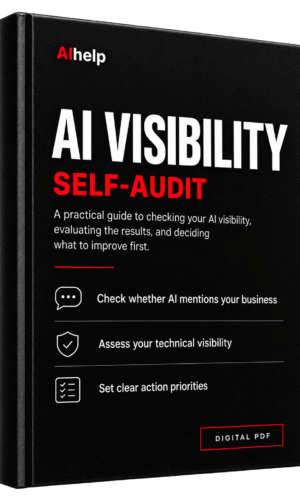
Self-Guided AI Visibility Audit
Step by step, you will check whether ChatGPT, Gemini, Perplexity, Google AI Overviews and other AI systems know, understand, recommend and cite your business. You will identify the main AI visibility problem and priority area for improvement.
→ Conduct an AI visibility audit yourself
A guide to increasing AI visibility for business
A more comprehensive toolkit for those who want to not only assess the current situation, but also prepare their website for AI search, optimize content, and consistently track visibility changes. The toolkit includes a PDF guide, practical ChatGPT queries, a Google Sheets/Excel tracking template, and a 30-day action plan.
→ Create an AI visibility improvement system
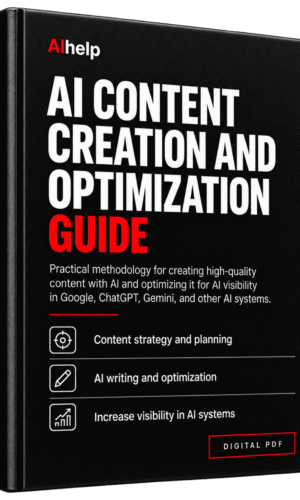
Content creation with AI and optimization for AI visibility
If the audit showed a lack of suitable content, this guide will provide you with a methodology for creating and optimizing articles, product descriptions, and website texts for SEO and GEO principles.
→ Create AI-enabled content for visibility
How to choose?
Just want to know where you are now? → AIclicks or Self-guided AI visibility audit.
Do you want to independently move from audit to improvement plan? → A guide to increasing AI visibility for business.
You already know that the problem is in the content? → Content creation with AI and optimization for AI visibility.