
What determines whether Google AI displays your content?
Artificial intelligence (AI) is changing the world of online search. While Google’s algorithms used to rely heavily on keywords and link networks, today Google’s AI-generated answers are playing an increasingly important role. This means that search results are no longer just a list of links – AI creates summarized answers based on trusted sources.
Businesses, bloggers, and SEO professionals are faced with a fundamental question: what determines which content is selected and displayed Google AI in the answers?
This topic is particularly relevant today, as the integration of AI into search has changed the rules of the game. Quality content alone is no longer enough – new standards must be met: reliability, clarity and structure.
How does Google AI select content?
Google AI is based on three main criteria: content quality, reliability and compliance with user needs.
1. Content quality and clarity
- The text must be written for people, not just algorithms;
- The first 200 words determines whether the AI will recognize the topic of the text;
- Very important structure – H2 and H3 headings, lists, concise answers.
2. EEAT + O principle
This is Google's content quality standard, which includes:
- Experience – practical examples, case studies;
- Expertise – research, statistics, expert insights;
- Authority (Authoritativeness) – links to reliable sourcesI;
- Trustworthiness – clear facts, dates, quotes;
- Uniqueness (Original Insights) – your own insights, not just rewritten information.
3. Compliance with user needs
- The content has to answer questions directly;
- Submit context and specific action steps;
- Be optimized for rapid understanding – so that AI can easy to use answer.
Real-world examples: what has already made it into Google AI answers?
HubSpot content marketing
HubSpot blogs are often displayed Google AI in the answers when people search for information about SEO, marketing, or sales. Why?
Because their content is structured in question-answer format, supplemented with practical examples and visuals, and statistics constantly updated.
Healthline health content
Health is one of the most sensitive topics, so AI prioritizes only authoritative sources. Healthline The articles are chosen because:
Them reviewed by doctors, they are supported scientific research, and the text is clearly divided into "What? Why? How?".
McKinsey insights on AI and business
McKinsey analytical articles constantly appear in AI reviews. Why?
Because they provide unique analysis, relies heavily on statistics and facts and emphasizes practical application for business.
Small businesses and bloggers
Į Google AI Not only big names can get responses. For example, travel blogs or niche e-commerce sites are shown if they:
have a clear question-answer structure, presents a unique experience and regularly updates content.
What can I do to get my content into Google AI answers?
- Write in question-answer format. AI recognizes content more easily when questions are clear and answers are short and to the point.
- Include reliable sources. At least 1 internal link is recommended (e.g. to aihelp.lt) and 1-2 external links.
- Use simple language. Avoid excessive words – the text should be clear and easy to read.
- Optimize technical SEO. Fast page loading, mobile-friendly, clean HTML and meta descriptions.
- Update content regularly. Review articles at least every 3-6 months, update dates, statistics, and links.
AIhelp.lt – GEO content experts, offering free consultation. We invite you contact and find out Can your website be found and cited by artificial intelligence?. Or we invite you to perform AI visibility audit, after which you will receive specific recommendations on how to improve your visibility Google AI and Chat GPT answers.
FAQ
Summary
To get your content shown by Google AI, you need to combine: quality writing + reliable sources + clear structure + regular updates.
This not only increases the chances of getting into AI-generated answers, but also ensures long-term organic search success.
This article was prepared in accordance with Google guidelines and SEO best practices.
Find out if AI is already seeing your business with AIclicks
Check if your brand is mentioned in ChatGPT, Perplexity, Google AI Overviews, and other AI systems, and see which queries your competitors are outperforming.
→ Check your AI visibility with AIclicks
Want to test and improve AI visibility yourself?
In this case, we suggest using AIhelp.lt's practical guides, which will help you independently conduct an AI visibility audit, prepare content suitable for AI search, correct weaknesses, and consistently improve your website's visibility in AI responses.
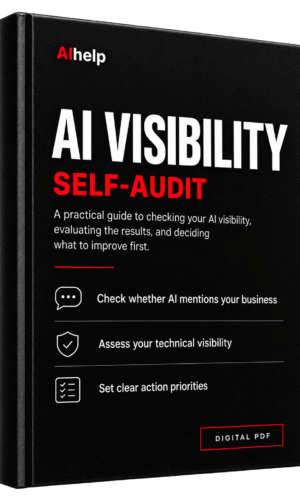
Self-Guided AI Visibility Audit
Step by step, you will check whether ChatGPT, Gemini, Perplexity, Google AI Overviews and other AI systems know, understand, recommend and cite your business. You will identify the main AI visibility problem and priority area for improvement.
→ Conduct an AI visibility audit yourself
A guide to increasing AI visibility for business
A more comprehensive toolkit for those who want to not only assess the current situation, but also prepare their website for AI search, optimize content, and consistently track visibility changes. The toolkit includes a PDF guide, practical ChatGPT queries, a Google Sheets/Excel tracking template, and a 30-day action plan.
→ Create an AI visibility improvement system
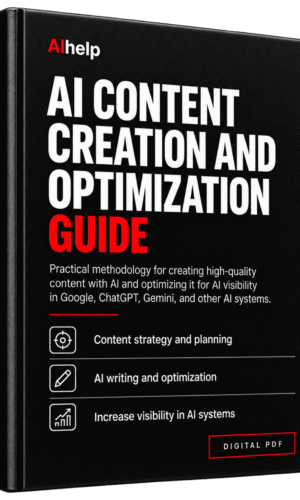
Content creation with AI and optimization for AI visibility
If the audit showed a lack of suitable content, this guide will provide you with a methodology for creating and optimizing articles, product descriptions, and website texts for SEO and GEO principles.
→ Create AI-enabled content for visibility
How to choose?
Just want to know where you are now? → AIclicks or Self-guided AI visibility audit.
Do you want to independently move from audit to improvement plan? → A guide to increasing AI visibility for business.
You already know that the problem is in the content? → Content creation with AI and optimization for AI visibility.