What is humanization of AI-written text?
Artificial intelligence can greatly speed up text creation, but the first version generated by AI is rarely the best final version. The text may be correct, but too general, predictable, full of identical sentence structures or phrases that a person would hardly use in a real conversation.
Humanizing AI texts – is the editing of AI-generated text so that it sounds more natural, more closely matches the brand voice, and provides more real value to the reader.
Humanization is not an attempt to „trick the AI detector.“ When doing this work professionally, the most important goal is not to hide how the text was created, but to make him a better person.
1. Naturalness and suggestibility
AI often chooses safe and universal formulations. The result may be correct, but the text lacks individuality, specificity, and natural rhythm.
Authentic content helps to convey a brand's position more clearly and speaks to the audience in a language they understand. HubSpot marketing statistics There is also a lot of emphasis on the importance of personalized and audience-relevant content.
When humanizing a text, it is worth asking:
- Does a person get specific information from it?
- Is that really how a specialist in this field would speak?
- Can the sentence be said more simply?
- Does the text have a specific brand feel, or could any company publish it?
2. Visibility in Google and AI search
It is important here to distinguish fact from the often repeated myth.
Google does not state that AI-generated text is inherently worse or automatically ranks lower. Important the purpose, quality, originality and benefit of the content to the reader. Mass generation of pages without added value may violate Google's policies, but using AI to generate content itself is not a problem.
Therefore, the benefits of humanization arise when editing:
- Generic and repetitive content is removed;
- Real knowledge and concrete examples are added;
- The user's question is answered more precisely;
- Text structure and readability are improved;
- Unfounded claims are removed;
- The depth of expertise on a specific topic is strengthened.
Google recommends creating useful and trustworthy content in its Human Content Guidelines, and emphasizes it in its 2026 Generative Search Guidelines. the importance of unique, expert-created content that provides more value than generic information.
This is relevant not only for traditional SEO, but also for visibility in Google AI Overviews and AI Mode. Google states that these AI features continue to follow the basic principles of SEO and content quality - there is no separate "humanized text" or GEO tag.
3. Brand tone
AI can follow a given tone, but without clear context, it usually prefers generic communication.
Therefore, the same texts quickly appear in AI texts from different companies, such as "helps achieve better results", "allows you to save time", "adapted to individual needs", "efficient and innovative solution".
The problem is not that every such phrase is bad, but if the entire text is made up of generic statements, it loses the uniqueness that is necessary for both the reader and AI robots.
Humanizing text restores the specific uniqueness of a brand's communication with its audience. Google states that these AI functions continue to apply the basic principles of SEO and content quality - using terms that are specific to it, maintaining the tone, explaining the real benefits, and removing phrases that any competitor could use.
4. Increasing conversions
The text of a product or service should not only convey information, but also help a person make a decision.
In place:
„"We offer high-quality and customized solutions."“
It would be much more useful to explain specifically what the customer gets, who the solution is for, what problem it solves, and what the person needs to do next.
Humanization is therefore especially important on product pages, service descriptions, advertising, and landing pages.
How to recognize that AI text needs to be humanized?
AI text does not necessarily have grammatical errors. It is usually not one specific phrase that gives it away, but a general writing pattern.
Pay attention if the text:
- Each paragraph begins similarly;
- The length and structure of sentences remain almost unchanged;
- Lots of abstract benefits, but few concrete facts;
- The words "important", "effective", "innovative", "optimal", "ensures" are used too often;
- The introduction does not spend much time answering the main question;
- One thought is repeated several times in different words;
- There are unnecessary conclusions after almost every chapter;
- Presents nice-sounding but unverified facts;
- Lack of specific company experience, examples or position;
- The text is technically correct, but "doesn't say anything.".
A good test is very simple: remove the company name and ask if five competitors could publish the same text. If so, the text probably lacks specificity.
How is AI text humanization done?
Humanization is more than just grammar corrections. Professional editing involves several separate steps.
1. First, the meaning of the text is checked
Before correcting the style, you need to make sure that the information provided by the AI is generally correct.
Check:
- Facts;
- Statistics;
- Product features;
- Price;
- Legal or technical statements;
- Sources;
- Tool features that may have changed.
A beautifully written, inaccurate text is still a bad text.
2. Redundant information is removed
AI often expands the same idea over several paragraphs.
Three questions can be asked for each paragraph:
Does it provide new information?
Does it help the reader understand the topic or take an action?
Hasn't this idea been said before?
If the answer is no, the paragraph should be shortened or removed.
3. Simplified language
Artificial intelligence sometimes prefers longer and more formal sentences, even though the same idea can be expressed much more simply.
Before:
„"Using this solution can enable businesses to more effectively optimize their daily business processes."“
After editing:
„"This solution can help businesses complete daily tasks faster."“
A shorter text is not necessarily simpler in terms of content. It simply conveys the idea more quickly.
4. The natural rhythm of speech is restored
In natural text, sentences are not all the same length. Some are short. Others are longer when a more complex idea needs to be explained.
Therefore, when editing it is worth:
- Vary the length of sentences;
- Avoid identical paragraphs;
- Sometimes the most important idea can be expressed in a short sentence;
- Don't write a list where two normal sentences would suffice.
Structured content helps the reader navigate, but headings and bullet points should serve a purpose and not be used simply because they are easy to generate. This principle has long been emphasized by Content Marketing Institute in content creation practice.
5. Adding specificity
This is one of the most important stages of humanization.
In place:
„AI can help businesses save time.“
write:
„You can use AI to draft your first customer letter, structure your product description, or create a weekly social media plan.“
The second option not only sounds more natural – it also provides more information.
6. Examples and real-life situations are included
If the topic is more complex, a theoretical explanation alone is often not enough.
Can include:
- A brief business situation;
- „"Before and after" example;
- A specific use case for the product;
- The most common customer question;
- A practical error and its correction.
This not only makes the content more natural, but also makes it harder to replace with another generic AI-generated article.
7. Organized CTA
AI loves universal prompts:
„"Learn more", "Discover opportunities", "Start today".
A more professional CTA directly addresses the reader's problem.
For example:
→ Check your AI visibility independently
or:
→ View AI text editing methodology
In this case, the reader clearly understands what awaits him after clicking.
An example of AI humanization
AI-generated text
„"Our services are efficient and tailored to a variety of businesses. They allow you to improve productivity and achieve better results."“
Humanized version
„"We help businesses reduce repetitive tasks, simplify content creation, and practically apply AI in their daily operations."“
The second version is stronger not because it uses more emotion. It tells more specifically what the company actually does.
This is an important distinction: good humanization is not artificial „warming up.“ First, it is increasing specificity, clarity and naturalness.
Can AI humanize text created by another AI?
Yes, AI can be used for editing. However, simply asking „humanize this text“ often doesn’t yield good results.
The system can simply:
- Change synonyms;
- Add more emotional words;
- Shorten some sentences;
- Change a few phrases while keeping the same general structure.
It is much better to give AI a specific editing task, such as: removing repetitions, shortening redundant phrases, keeping facts, avoiding advertising clichés, and highlighting areas where specific data is missing.
The final text should still be human-reviewed, especially when it contains information about products, services, pricing, health, finance, law, or technical matters.
More about AI humanizing texts we invite you to read the AI guide here.
Common mistakes in AI text humanization
Too much colloquial language
Natural text doesn’t have to be familiar. On a B2B services, finance, or professional consulting website, a too casual tone can even reduce trust.
Changing synonyms instead of actual editing
Changing "effective" to "effective" does not make the text more human. It requires correcting the thought, structure, and concreteness.
Changing facts for a more beautiful style
Editing cannot "improve" numbers, product features, or other facts.
Artificial personal stories
If real experience is not available, there is no need to invent it just to make the text seem more authentic.
Too much focus on AI detectors
The goal should not be to achieve a certain "human score", but to create text that is accurate, useful, and appropriate for a specific reader.
FAQ
Do you want to edit AI texts professionally yourself?
If you are already using ChatGPT or other AI tools for articles, product descriptions, website copy, or social media content, the next step is to learn how to edit the drafts they create with high quality.
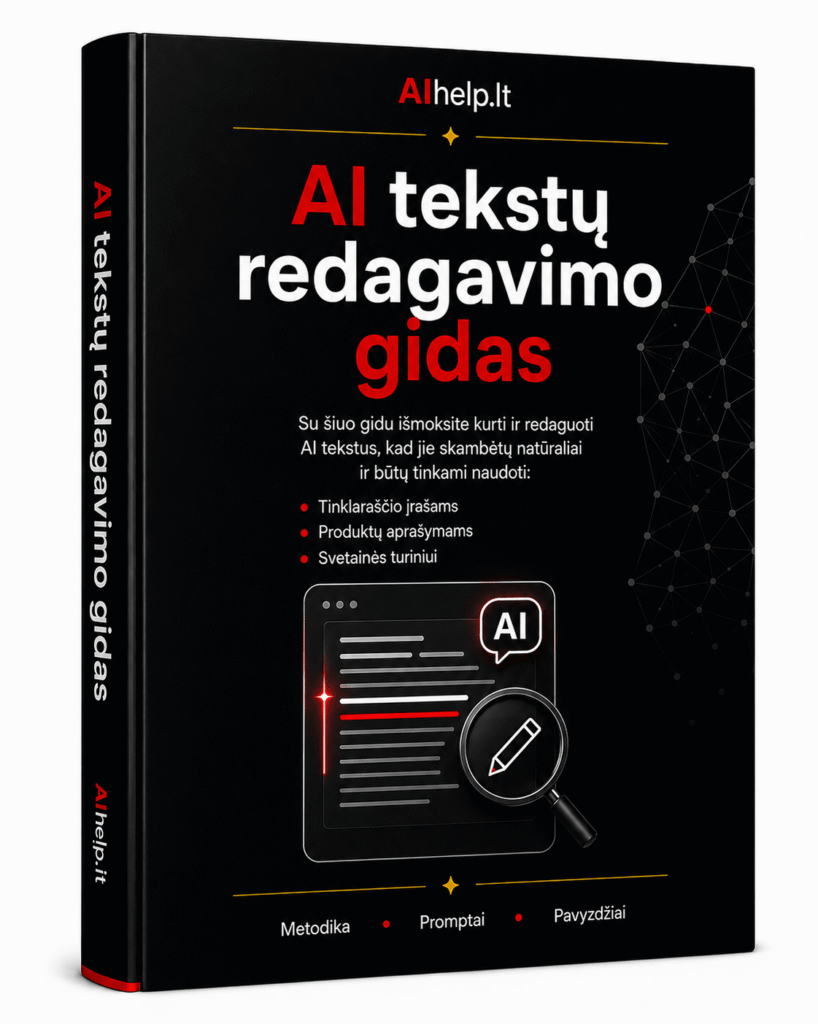
AI Text Editing Guide will help you identify unnatural areas of AI text, remove repetitions and common phrases, improve the rhythm of the text, and maintain a professional brand tone.
All AIhelp.lt AI guides