How are Google AI answers changing SEO strategies?
Artificial intelligence is changing the way people use Google search. It is taking on an increasingly important role alongside traditional organic results. AI Overviews and AI Mode – Google's generative search features, which can summarize information, compare different options, answer more complex questions, and provide links to sources.
This doesn't mean that traditional SEO no longer works. Google indicates that generative search features are based on Google Search's core ranking and quality systems, so technical SEO, indexing, quality content and a clear website structure remain the foundation.
So what changed? To understand this, in this article we will discuss:
- What are Google AI Overviews and AI Mode;
- How Google's generative search finds information;
- How AI features are changing SEO strategy;
- What new visibility metrics are worth monitoring;
- What content is needed;
- What GEO and AI SEO actions Google doesn't actually require;
- What specific changes are worth making to your website?.
What are Google AI-generated answers?
The evolution of Google's generative search began with an experimental Search Generative Experience (SGE), introduced at Google I/O 2023.
Current name AI Overviews appeared later. May 2024 Google began rolling out AI Overviews more broadly in the US and later expanded the feature to other markets.
AI Overviews can:
- To summarize a more complex topic;
- To answer a specific user question;
- Provide steps or comparison;
- Link information from multiple sources;
- Provide links to websites where the topic can be explored in more detail.
AI Overview is not displayed for every query. Google It is provided when the system determines that a generative answer can provide additional value beyond the regular search results.
AI Overviews and AI Mode – what's the difference?
AI Overviews
AI Overview usually works as generated overview of information on a regular Google search results page.
It may appear when a question requires a more extensive explanation, multiple sources of information, or a clearer summary.
AI Mode
AI Mode is designed for deeper and more dialogic search. In it, the user can:
- Submit longer queries;
- Compare multiple choices;
- Ask additional questions;
- Analyze more complex situations;
- Continue the search using the dialogue principle.
This is also changing SEO. People are increasingly searching not only for short keyword phrases, but also describing the entire problem or solution situation.
How does Google AI find information for answers?
Google's generative search features are not completely separate from the regular Google Search system. They rely on Google's index, search engines, and various information retrieval mechanisms.
Searching for information before generating a response
Generative search can use the principle of first finding relevant Internet sources before forming a final answer.
In simplified terms, the process can be imagined as follows:
User query → relevant information is found → sources are evaluated → AI response is formed → links to sources are provided.
This means that the usual SEO basics remain important. If a page cannot be properly found, indexed, or understood by Google, its chances of being used in generative search also decrease.
What is query fan-out?
AI Overviews and AI Mode can use the so-called query fan-out principle. Google can generate multiple related searches from a single complex user query, thereby gathering information about different aspects of a topic.
For example, a person asks:
„"What AI tool is best for a small e-store?"“
The system can additionally analyze:
- AI tools for product descriptions;
- AI for customer service;
- E-commerce automation;
- Tool prices;
- Integrations with WooCommerce or Shopify;
- Comparisons of different tools.
Therefore, a page does not necessarily have to answer the entire complex query. It can be valuable because it provides a very good answer to one specific aspect of it.
This increases the importance of thematic website architecture.
How are AI responses changing SEO strategies?
1. From individual keywords to topic and search intent
Keywords remain important in an SEO strategy. However, SEO is no longer about keyword density optimization.
Increasingly important are:
- What question does the person want to solve?;
- What additional questions does he have?;
- What information is needed for selection;
- What options is a person comparing?;
- What is his next step in the decision?.
Therefore, one good page can naturally answer several closely related queries.
For example, an article about AI visibility might explain:
- What is AI visibility;
- How to check it;
- How is a mention different from a quote?;
- Why might AI recommend a competitor;
- How to monitor visibility;
- What to improve first.
Google It is also not recommended to create a separate page for each weak variation of a long-tail query. Search engines are able to understand synonyms and the general meaning of the content.
2. The goal is not just to get to the AI answer
The goal of SEO remains a business outcome, but in the era of generative search, it is important to:
- Be visible in traditional search;
- AI Overviews or AI Mode appear;
- To be presented as a useful resource;
- To receive a qualified visitor;
- Convert a visitor into a customer, subscriber, or inquiry.
Therefore, citing or mentioning AI is visibility indicator, but not the ultimate business goal.
3. New SEO measurement criteria are emerging
Traditionally, SEO results are measured by:
- Organic positions;
- Testimonials;
- Clicks;
- Organic traffic;
- Conversions.
These indicators have not disappeared. However, they are being contributed to visibility in generative search.
2026. Google has started rolling out separate Generative AI Search Performance reports in Search Console to analyze visibility in AI Overviews, AI Mode, and other generative features. They can provide information about:
- Demonstrations in generative functions;
- The pages that have appeared;
- Country;
- Devices;
- Changes in visibility over time.
Because features are being rolled out gradually, they may not be available for every website yet.
4. AI responses change the value of the click
AI Overview can provide enough information that some users no longer need to open an additional page. Therefore, it is worth considering more than just the total number of visitors in an informational SEO strategy. It is important to monitor:
- What queries attract visitors;
- What other pages do they go to?;
- Are you reviewing products or services?;
- Does it fill out forms?;
- Are you registering?;
- Are you making a purchase?.
SEO success increasingly depends not only on the amount of traffic, but also its quality.
5. Content must be not only clear, but also valuable
Clear H2 and H3 headings, lists, tables, and short answers improve the readability of your content. However, structure alone is not enough. Google The generative search guidelines emphasize unique, useful and expert content, providing the user with more than the general information already available on the Internet, therefore becoming more valuable:
- Own research;
- Practical tests;
- Case studies;
- Expert conclusions;
- Original data;
- Practical methodologies;
- Product or service comparisons;
- Real work situations;
- First-person experience.
For example:
Generic article:
„"5 Ways to Use ChatGPT in Business."“
An article that creates greater expert value:
„"We tested ChatGPT in customer service for 30 days: what we automated, where the AI went wrong, and what we left to the employee."“
The second content provides something that cannot be easily replaced by another generic AI-generated summary – real experience and original conclusions.
6. EEAT and reliability
EEAT means:
- Experience – experience;
- Expertise – competence;
- Authoritativeness – authoritativeness;
- Trustworthiness – reliability.
EEAT is not a single Google ranking score. It is a quality assessment principle that helps you understand whether content can be trusted. In practice, it is worth taking care of your website:
- Clearly indicated authors;
- Author's expertise information;
- Reliable sources;
- Publication and update dates;
- Examples of real experience;
- Clear company information;
- Contacts;
- Consistent expert topic.
It is important not only to claim that you are an expert, but also demonstrate competence in the content itself.
Technical SEO in the era of Google AI
In order for a page to be listed as a resource in AI Overviews or AI Mode, it must first be available for Google search. As indicated Google, there are no additional special technical requirements for Google AI features alone, so it's worth checking:
- Are the most important pages indexed?;
- Can Googlebot access them?;
- Is there no unintentional
noindex; - Are important pages accessible through internal links?;
- Is the main content presented in a format that Google understands?;
- Is the website mobile-friendly?;
- Is there unnecessary duplicate content?;
- Is the website's speed critically poor?.
Generative search does not replace technical SEO – it is based on the same technical basis.
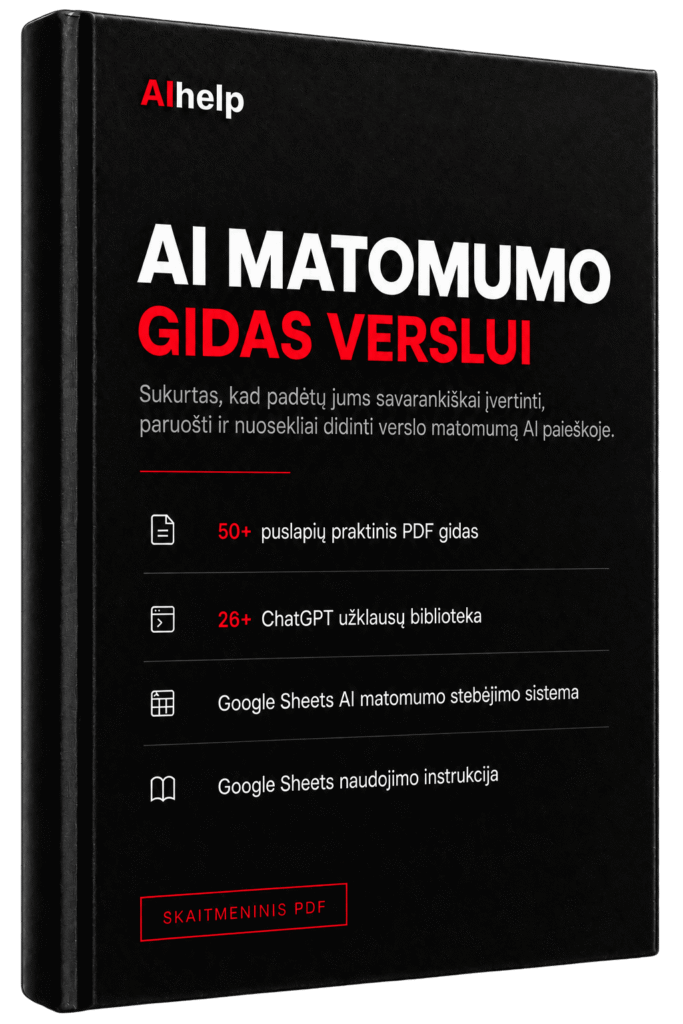
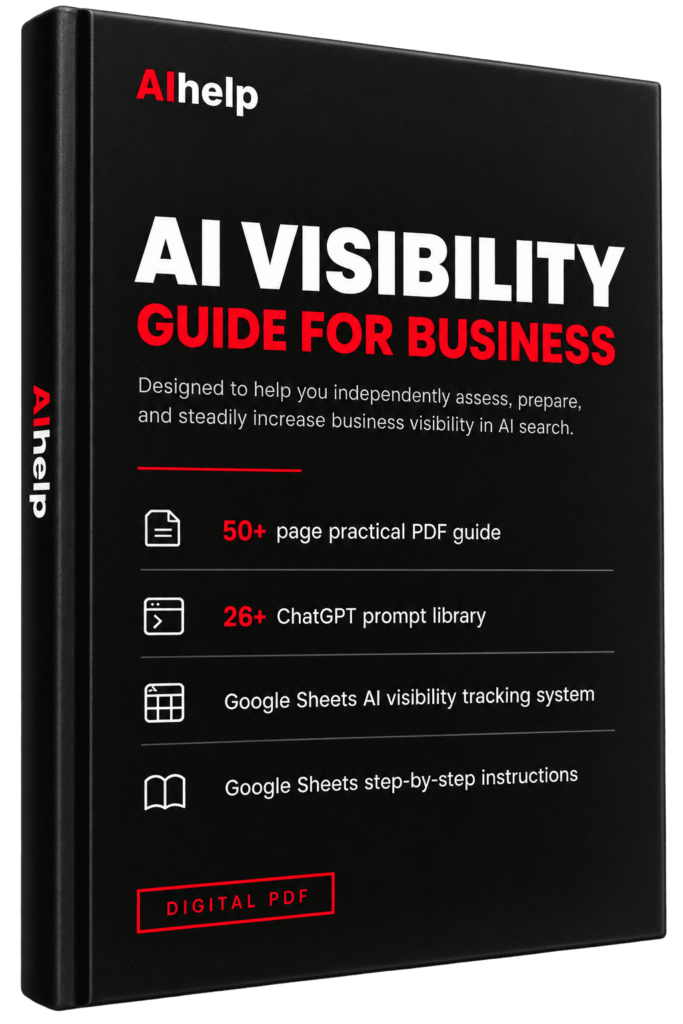
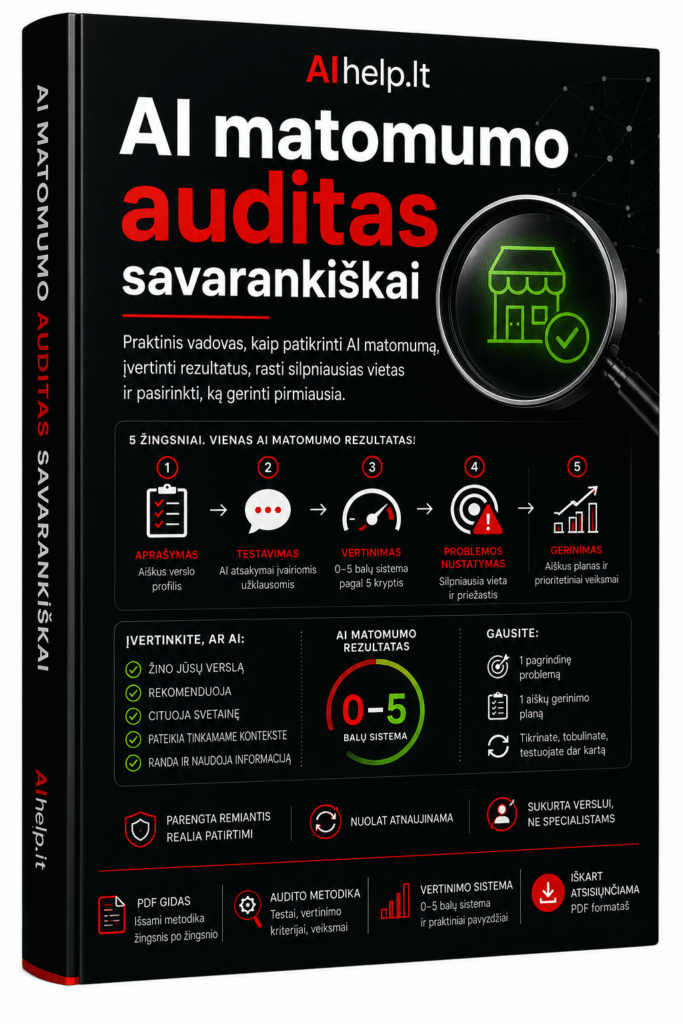
To learn more and independently optimize your websites for AI visibility, read AIhelp's AI guides here: https://aihelp.lt/ai-gidai
Comparison of Traditional SEO and Google Generative Search
| Aspect | Traditional Google search | Google AI Overviews and AI Mode |
|---|---|---|
| Inquiries | Often shorter | Can be long, contextual, and ongoing |
| Result | Organic results and other search elements | Generative answer with source references |
| SEO basics | Technical SEO, content, relevance, links | Same basic SEO principles |
| Content strategy | Search intent and topics | Context, thematic depth, and original value are even more important |
| Keywords | Remains important | Greater importance given to context and user intent |
| Measurement | Impressions, clicks, positions, conversions | Additionally – visibility in generative functions |
| EEAT | Relevant to trusted content | Also important for expert and trustworthy content |
| Scheme | Useful for supported search results | There is no special AI scheme. |
| Contents | Useful and relevant | Original, expert and non-generic content is especially valuable |
Can AI-generated content be visible on Google?
Yes, because Google does not indicate that AI-generated text is inherently inferior or automatically ranked lower. The key is content quality, reliability and its purpose.
Generative tools can be used to:
- For research;
- For ideas;
- Content structure;
- For the first draft;
- For editing.
However, the mass creation of low-value information to manipulate search results may violate Google's spam policy.
Practical work sequence:
AI draft → fact-check → expert addition → editing → SEO optimization → publishing.
FAQ
Conclusion
Google's Generative Search Doesn't Kill SEO - It Does expands the environment in which websites compete for visibility.
Today, a strong SEO strategy must combine:
technical accessibility + useful content + thematic authority + original expert information + clear website architecture + results measurement.
Keywords remain important, but they alone are no longer enough. It is even more important to understand the real questions of the user and provide information that helps solve the problem or make a decision.
Generative search also opens up new possibilities. Google can examine a complex query from multiple perspectives, so your quality page can be discovered even when it only answers one specific part of a broader question.
For this you first need to have high-quality, indexable, reliable and value-adding content.
The goal of SEO shouldn't just be to get to the AI answer. The real goal is to to be found at the right moment, provide a reliable answer, and turn visibility into real business value.
Want to test and strengthen your website's AI visibility?
If you want to not only understand how Google AI search works, but also practically evaluate your website, AIhelp.lt guides will help you independently check visibility, identify key gaps, and develop specific next steps.
AIhelp.lt AI guides
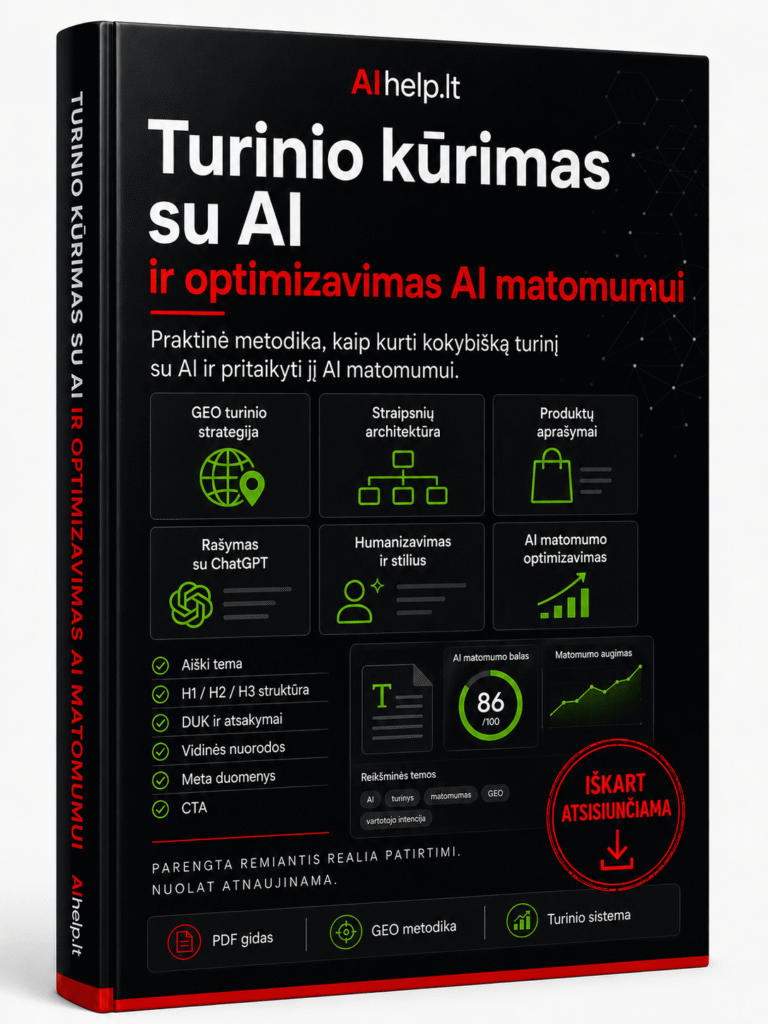
If you already use ChatGPT or other AI tools for product descriptions and website copy, AI Text Editing Guide will help you remove common AI phrases, repetitions, and artificial tone and prepare the text for publication.